
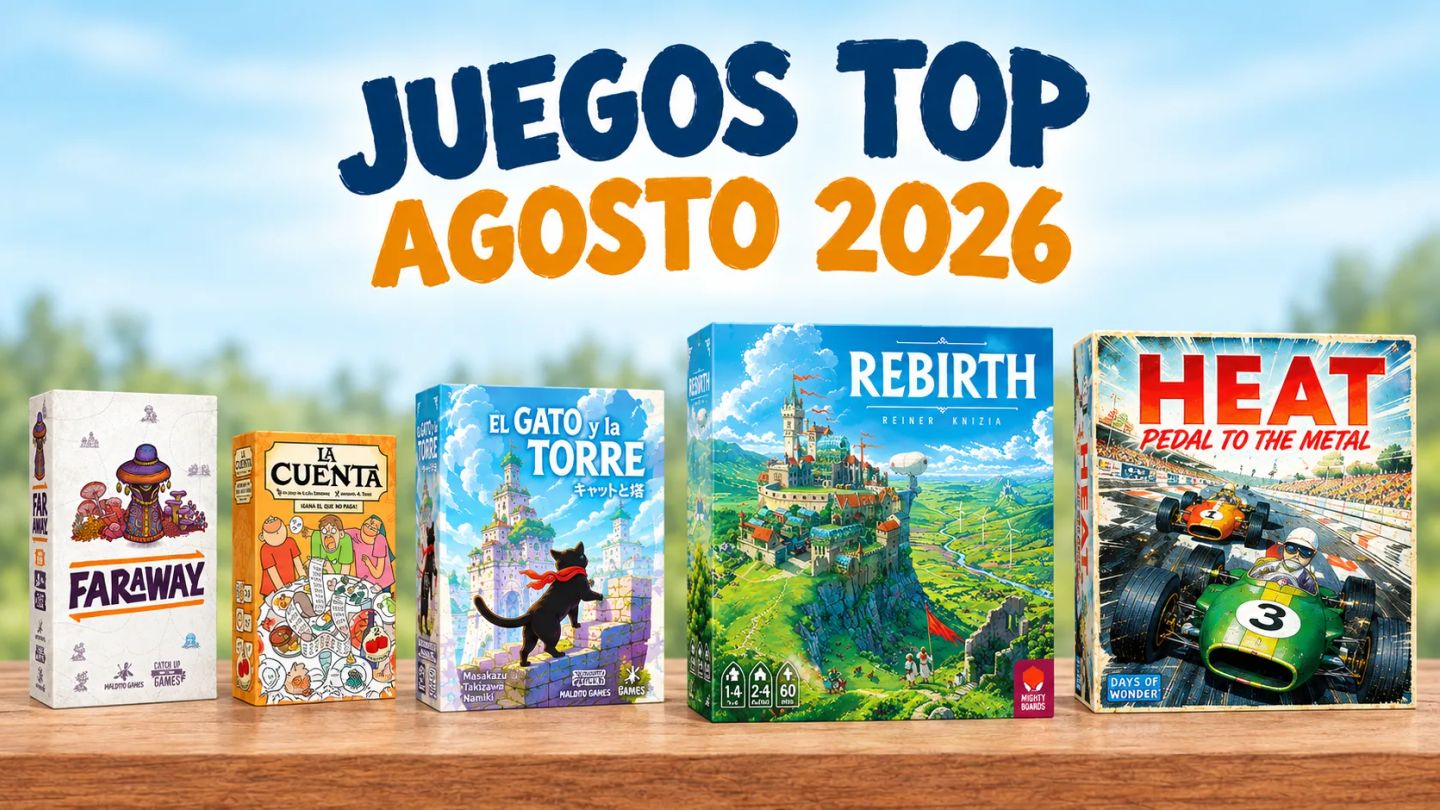
Most Played Board Games in August
August has been an intense month at our Wednesday game nights. Between the summer heat and the desire to unwind in good company, KLEFF's tables haven't stopped: dozens of different titles have been played, from classics that have been with us for years to the latest additions to our game library, which now boasts over 700 games available for members and visitors.
In this review, we wanted to highlight five games that marked the month: two newly arrived games that have already become table regulars (Rebirth and El Gato y la Torre) and three titles that have been in our collection longer but became major protagonists again in August: La Cuenta, Heat: Pedal to the Metal, and Faraway. Each of them represents a very different game style: from the measured territorial management of Rebirth to the adrenaline of a car race in Heat, passing through the table bluffing of La Cuenta, the condensed strategy of Faraway, and the cooperative dexterity of El Gato y la Torre, which gives a good indication of the variety of profiles and tastes that gather every week at our tables.
If you'd like to try any of them, you can check their availability in our online game library, where all the titles in the KLEFF collection are listed, and reserve them for your next game.
Rebirth: the new Knizia that's sweeping the tables
We start with the big new release of the month: Rebirth, the latest design by Reiner Knizia, published in Spain by Devir.
In Rebirth, each player represents a clan seeking to rebuild a territory (Scotland or Ireland, depending on the chosen board side) after a great catastrophe. On each turn, there's only one decision: place the single tile you have in hand (farm, energy farm, or settlement) in the board space that best benefits your clan, scoring points immediately for connecting crops, founding communities, and gaining control of castles and cathedrals.
You can consult the complete rules in the official Rebirth manual.
Each type of tile scores differently. Energy and food farms award one point for each tile of the contiguous group of your color to which the new piece is added, so the larger you make a cluster, the more profitable each new tile you place in it. Settlements work differently: small, medium, or large depending on the number of spaces they occupy, and when completed, they distribute points among players with the most influence (number of settlement symbols) in that area, always rewarding whoever contributed the most. Placing tiles next to cathedral spaces also allows you to draw private mission cards with objectives that will add extra points at the end of the game, while occupying more spaces than anyone else around a castle gives you control over it and, with it, guaranteed points at the end of the game. The game concludes as soon as all players have placed all their tiles, at which point points for incomplete settlements, controlled castles, and fulfilled missions are tallied to determine the winner.
Although its setup on the table is impressive at first glance, as the board quickly fills with colorful tiles and symbols, Rebirth is a very accessible game for any player: the turn is explained in five minutes, and anyone, whether or not they have prior experience with board games, immediately understands what they need to do. This combination of light rules and weighty decisions is Knizia's signature and is exactly what is making Rebirth a resounding success at our game nights. Additionally, the game includes a second map, Ireland, with slightly more advanced rules (shared public missions, round towers with bonuses, and settlements of up to four spaces), which gives it extra longevity once the group has mastered the Scottish version.
Reiner Knizia is, without a doubt, one of the most prolific modern board game designers in the world, a doctor of mathematics and responsible for hundreds of designs published over more than three decades of his career, including some of the best-selling dice and card games in hobby history. In our game library, we have several of his titles, such as Piko Piko, also known internationally as Pickomino, a fast-paced dice game where you have to risk rolls to get the best worm tiles before another player takes them, Lost Cities: a classic two-player card game about archaeological expeditions, considered one of Knizia's masterpieces, and Mille Fiori, a tile-placement game with Venetian glass mosaics, of longer duration and strategic weight. If you liked Rebirth, any of these three is a good option for your next game at KLEFF.
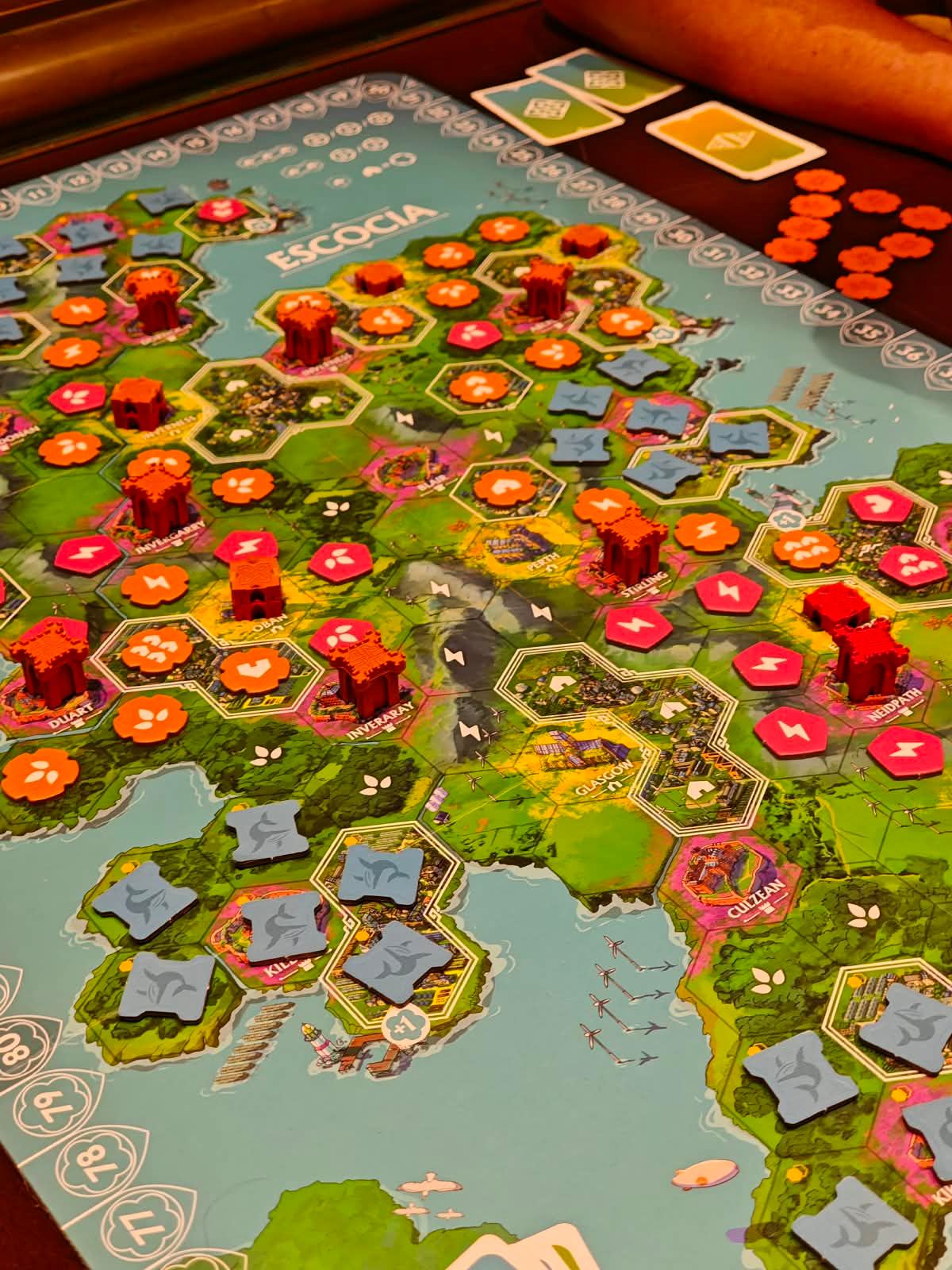
Rebirth
La Cuenta: the tapas filler that never fails at any table
We continue with one of the most played card games at KLEFF, month after month: La Cuenta, by 2 Tomatoes Games.
The premise is as simple as it is recognizable: a group of friends goes out for tapas, bar after bar, and in each round someone will have to pay the bill... preferably not you. In turns, each player places a tapas card (meat, fish, or vegetable) or a special card on the table. When someone cannot or does not want to continue playing, they ask for the bill and pay what has accumulated in that round. The game ends when a player runs out of savings, and the winner is whoever retains the most money. You can consult the complete rules in the official rules of La Cuenta (2nd edition).
The interesting thing is that it's not enough to play any card: each tapa is placed in its corresponding column, and its value must be equal to or greater than that of the last card played in that row, so the bill can only go up. Added to this are special cards that break the routine and add pure bluffing: the burned plate blocks an entire row, the coffee freezes almost all the action of the round, and the split bill card divides the cost of the bill among everyone present. When a player cannot or does not want to play any more cards, they ask for the bill, pay what has accumulated in that round from their savings, and they start visiting the next bar. The game ends when someone runs out of savings, and then the winner is whoever retains the most money.
Its success at KLEFF has a clear explanation: it's fast (games of barely 15-20 minutes that are completed almost in one go), it has a very fun theme that everyone instantly recognizes—who hasn't argued about who pays for the round of tapas?—and illustrations with a lot of personality. Added to this is very high direct interaction: it's not a game where everyone goes their own way, but rather one player's decisions immediately affect others, which generates those moments of tension and laughter that make a game always call for another. It's one of those games that fit perfectly between games, as a warm-up filler upon arriving at the table or as a perfect closer to a game night.
With this level of success at our tables, we will organize a La Cuenta tournament in October! Stay tuned to our social media, where we will announce the date and registration method as soon as they are finalized.
And for those who follow the game's trajectory closely: La Cuenta has already been translated into German and will be published by Pegasus Spiele, one of the great references in board game publishing in Europe. News that confirms what we at KLEFF already knew: this filler has international appeal.
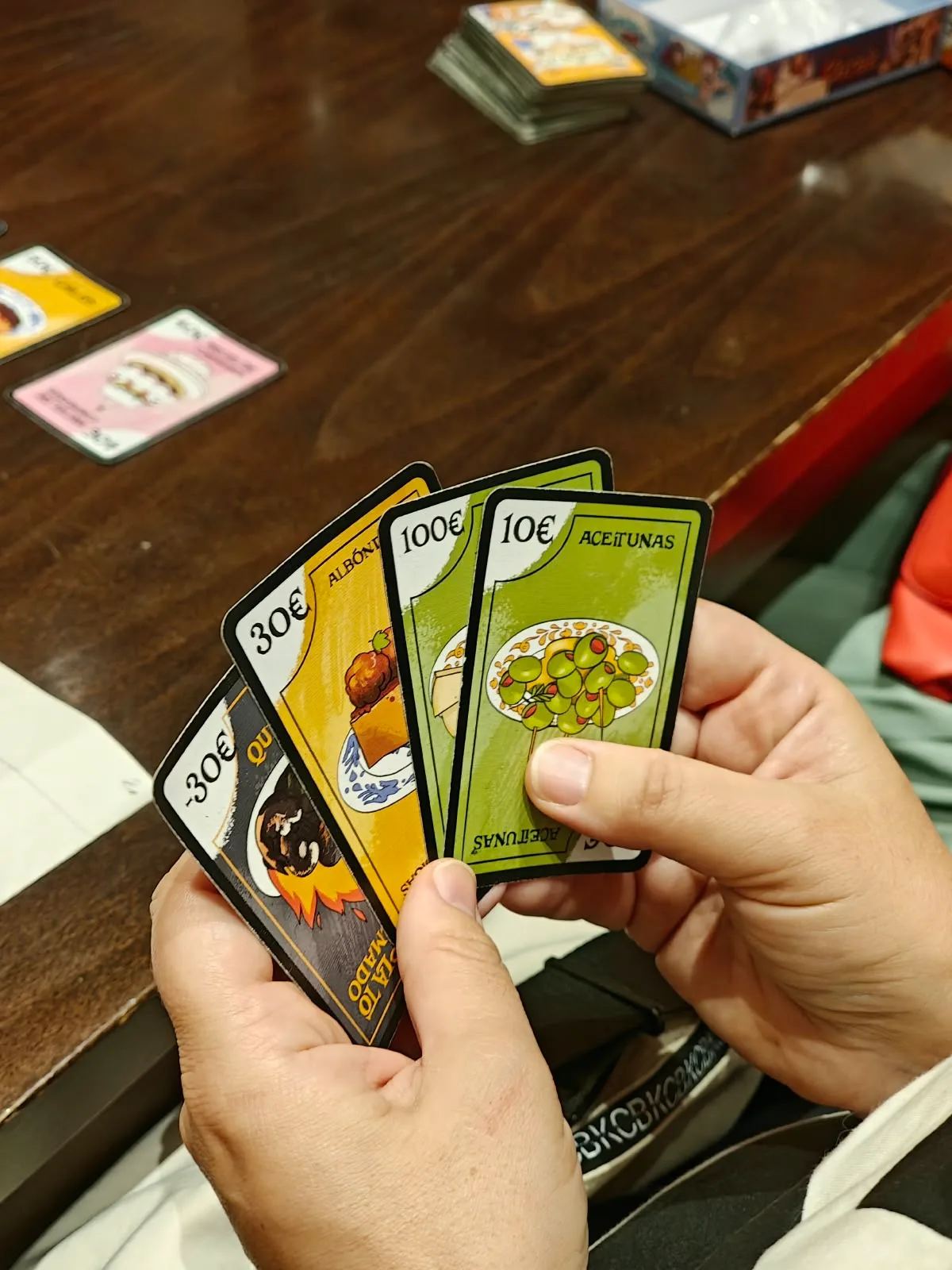
La Cuenta
Heat: Pedal to the Metal, pure gasoline at our game nights
Another staple at our August tables (and any month) has been Heat: Pedal to the Metal, by Days of Wonder.
Heat is a racing game with deck management set in 1960s and 70s Formula 1, where each player pilots a car around a real or invented track, combining numbered speed cards (0 to 5, plus some wildcards) to advance the maximum number of spaces possible without losing control on the turns. Each player has a hand of seven cards and, on their turn, plays as many as allowed by the gear they are in (between 1 and 4), being able to shift up or down one gear per turn for free. You can consult the complete rules in the official Heat rules.
The key is to manage engine heat well: pushing it allows you to change two gears at once instead of one, but each time you do, you add a heat card to your own deck, which will take up space in your hand and reduce your room for maneuver in future turns unless you cool it down by playing in low gears. Added to this are stress cards, true wildcards of unknown value that force you to draw an extra card from the deck when played, adding that characteristic point of uncertainty to the design. Managing well when to risk on the straights and when to brake before a turn (each turn has a speed limit that, if exceeded, causes loss of control and setback) is what separates drivers who arrive first from those who get stranded halfway through the track.
On July 1st, we organized a Heat tournament at KLEFF that was a great success in participation (you can see the full event at our Meetup), and interest in the game remained very much alive throughout August, with several tables repeating races every week. Part of Heat's charm is that the international community of players constantly creates custom tracks with their own layouts, turns, and difficulty levels to vary the racing experience beyond the official tracks included in the base game box and its expansions. A good example is the fanmade Montjuïc circuit (Barcelona), perfect for a race with a Barcelona flavor through the streets of the Catalan capital.
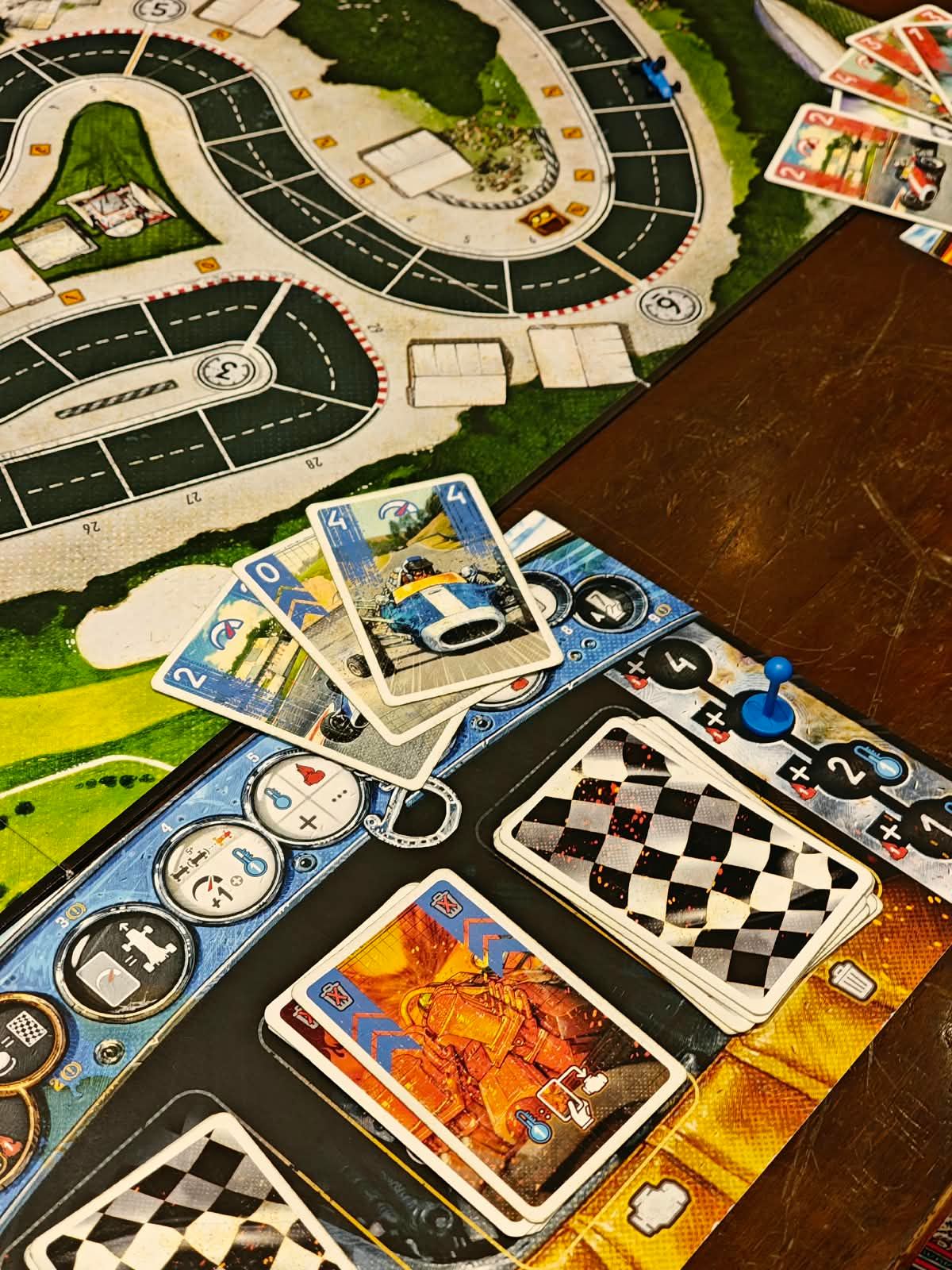
Heat: Pedal to the Metal
Faraway: exploring a continent that changes with each game
Among the card games that have been in our game library for a while and have come back to the table strongly in August is Faraway, by Catch Up Games and published in Spain by Maldito Games.
The game unfolds over eight rounds. In each round, all players secretly and simultaneously choose a region card from their hand of three and place it face down; when revealed, it is added to the right end of each player's exploration row. Then, each player chooses a new card from a shared river of face-up cards to replenish their hand, and here lies the strategic heart of the game: the turn order for choosing from the river depends on comparing the value of the card just played, so being among the last to choose can leave you with the worst options. You can consult a summary of the rules in Spanish in the Faraway rules.
The truly original aspect of the game lies in its scoring system: at the end of the eighth round, the cards in each player's exploration row are scored in reverse order of how they were played, meaning starting with the last card placed and ending with the first. Each region card represents a character with a scoring condition that only considers what is already visible at that moment of counting (cards that will be scored later, to the left, do not yet count). This forces players to constantly rethink what combos they are building and at what speed it is convenient to close each objective: playing a powerful card too early in the row can mean that, when it's time to score it, the conditions it needed are no longer met.
With games lasting barely 25 minutes and very high replayability thanks to the randomness of the region cards available in each round and the enormous variety of combinations between characters, Faraway is one of those games that, once its inverted scoring mechanism (which often surprises in the first game) is understood, hooks you for several rounds in a row. It is common to see it come to the table at KLEFF as a table-closer filler, when the group wants one last quick game before saying goodbye, and even as a starting point for a newly formed table.
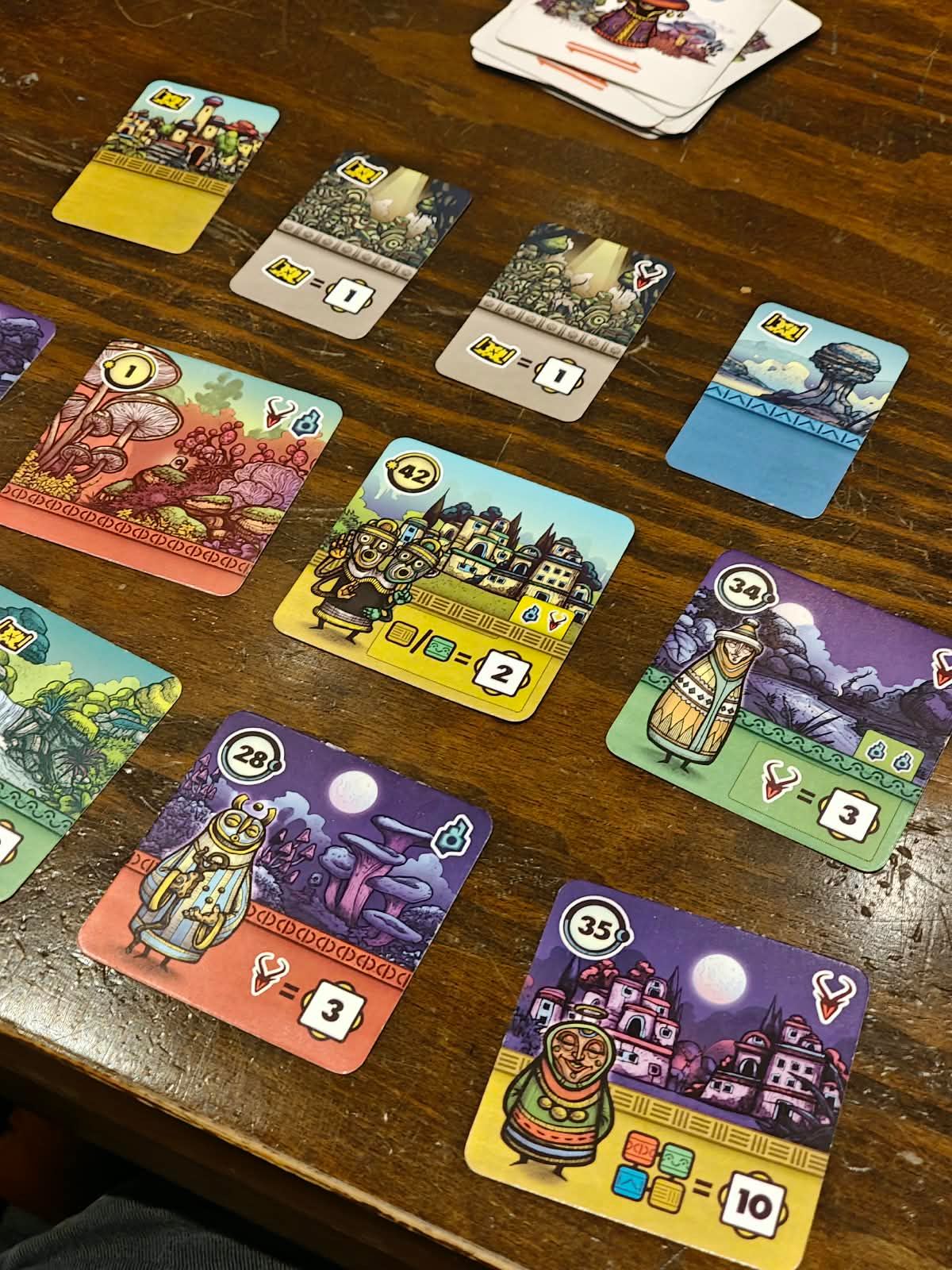
Faraway
El Gato y la Torre: dexterity, balance, and a lot of tension
We close with the other big new release: El Gato y la Torre, designed by Masakazu Takizawa and published in Spain by Maldito Games.
It's a cooperative dexterity and balance game where the entire group works together to help Toto, a black kitten, reach the tenth floor of an increasingly tall and unstable tower. On each turn, the active player chooses between two actions: build a new floor in the tower by carefully placing a floor card and, often, wall cards around it to reinforce the structure, or try to get Toto to climb a floor, which is only possible if certain conditions set by the mission cards in play are met (for example, having a minimum number of floors built, or having used a certain type of wall). The team also has action cards that can alter the rules of the turn or introduce special effects, adding variety to each game.
If Toto reaches the target floor indicated on the objective card before the tower collapses, the entire team wins the game; if the tower falls before, the group loses and must start over. The box also includes a competitive mode, created by the fan community and approved by the author himself, for those who prefer to compete against each other instead of cooperating.
It inevitably reminds us of Rhino Hero, another classic of building cardboard towers without them falling, but El Gato y la Torre significantly raises the difficulty and tension, making it a much more interesting proposition for an adult audience: the conditions of the mission cards and the placement restrictions—as certain pieces can only be supported in a specific way, or require using only one hand—force players to think about every move, not just have a steady hand. The result is a perfect mix of laughter, nerves, and that tense silence that takes over the table just before placing the final piece, something we have experienced firsthand at our August game nights.
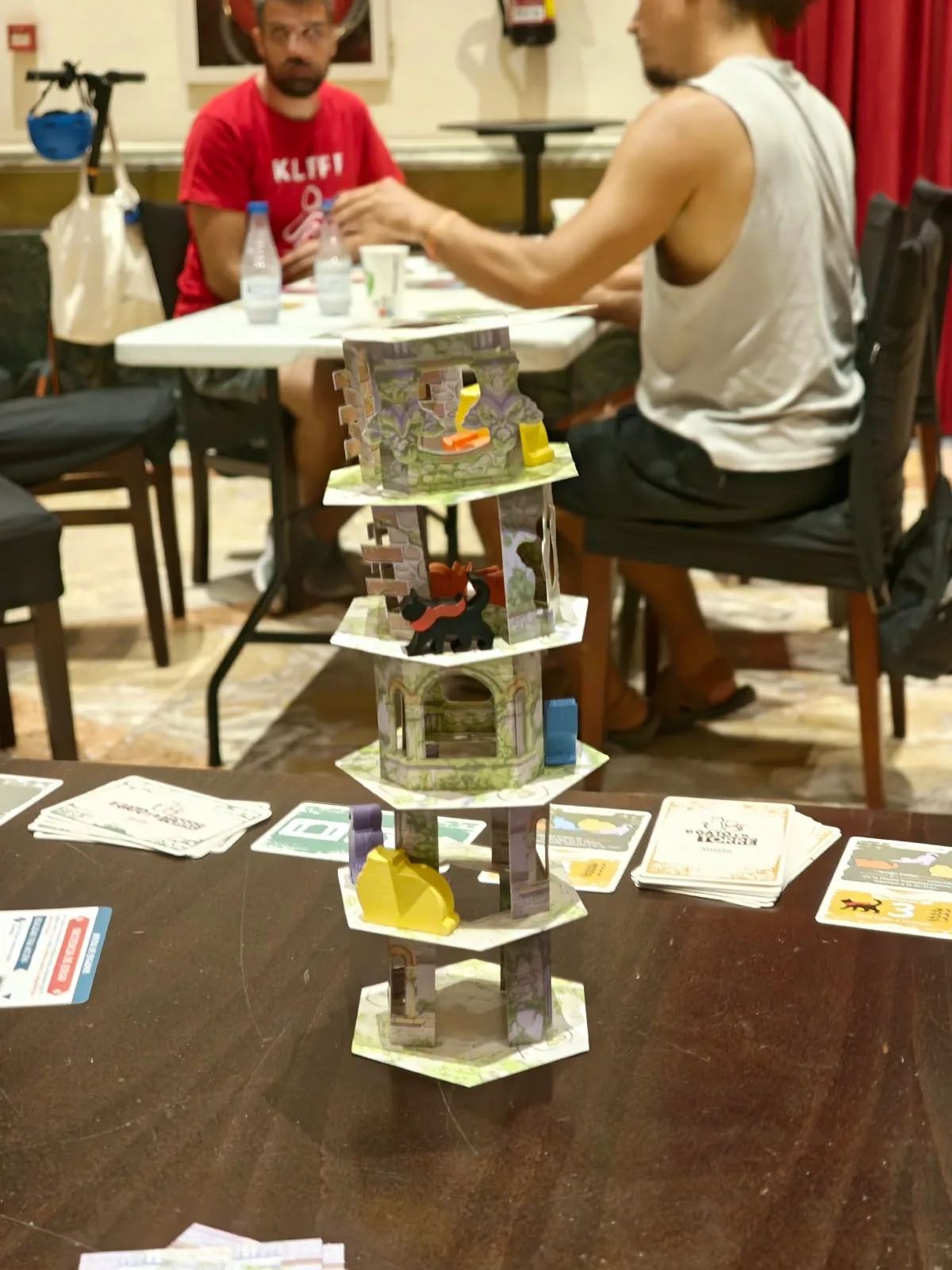
El Gato y la Torre
👉 Check out upcoming events and come to your first meetup on Meetup, follow us on Instagram @kleff.bcn or write to us from the contact page. We'll save you a chair.