Gods' Will: the Greek social deduction game taking Kickstarter by storm
A few weeks ago, a package arrived at KLEFF from George Manios and his Greek publishing house Breezy Games: Gods' Will, a social deduction and hidden roles game set entirely in Greek mythology that, as of the publication date of this post, is currently being funded on Kickstarter, having already well surpassed its funding goal. In this post, we explain how it plays and what we thought of it after testing it out in several of our gaming sessions. Ready?
A Greek engineer in love with game design
Before telling you what we thought, we think it's interesting to talk about its designer: George Manios. George is a civil engineer living on the Greek island of Naxos who has spent years combining his profession with board game design. His first creation, The Black Hand, won the Greek Board Game Design Contest in 2016 and ended up being published in 2024 as Omertà: The Five Families (Vesuvius Media); in 2022 came Tulip & Rose, published by Kaissa Chess & Games and available on Board Game Arena.
After racking up several awards in that same competition, he decided to found his own publishing label, Breezy Games, with a very clear vision: to publish games with simple rules but more depth than meets the eye. Gods' Will is his first title under this publisher, and according to Manios himself, it is also one of his favorite designs among all he has created.
Why at KLEFF we knew it was going to work
Over the past few weeks we have brought Gods' Will to several of our game nights to test it thoroughly, and the feedback from people who got to try the game in scheduled matches (some of them managed through our go-to platform for organising games: Ludoya) has been great.
Hidden roles, social deduction, and secret identity games are hugely popular at our game nights because they are designed for large groups and usually feature a lot of player interaction. At KLEFF we have a very active hidden roles community, so a social game of accusations, secret votes, and backstabbing was guaranteed to be a hit.
What it's about and how it plays
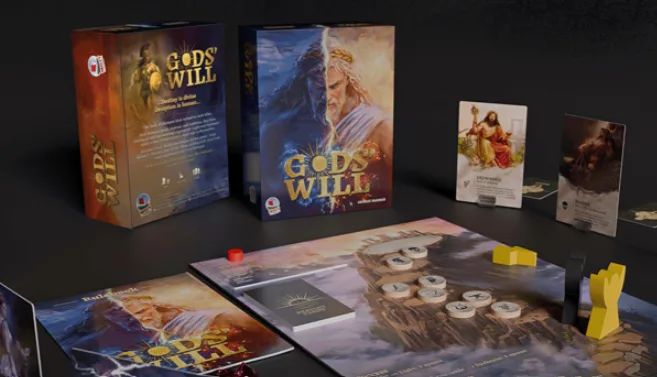
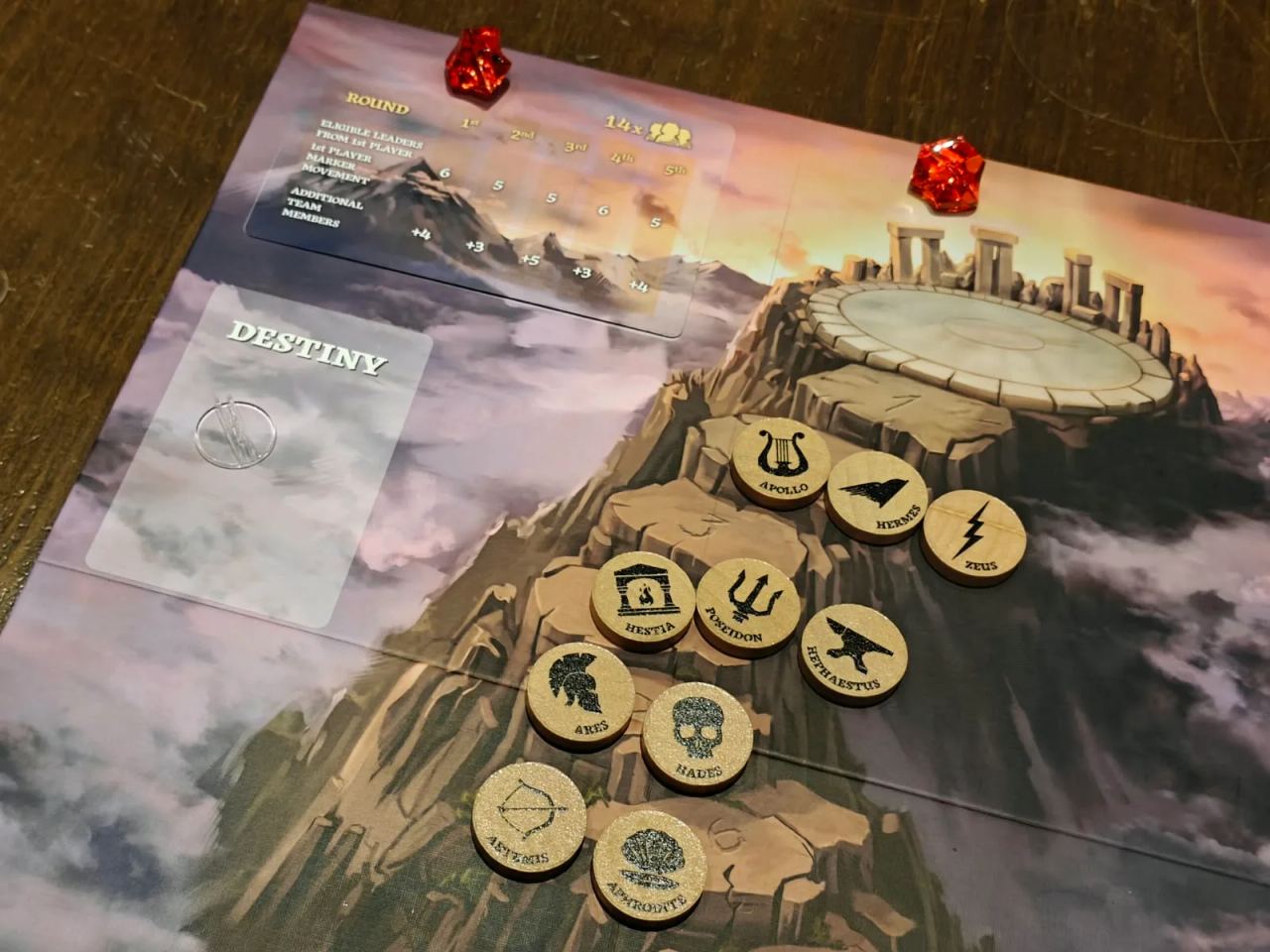
Gods' Will is a social deduction and hidden role game for 5 to 14 players, with games lasting around 45–60 minutes and a recommended minimum age of 14. Set entirely on Greek Mount Olympus, the box includes 14 god cards (double-sided), 17 role cards, 15 fate cards, 65 Mythic Venture cards, plus 5 Cosmic Venture cards for the Pantheon variant, ability tokens, and a board shaped like an ascending path toward the summit of Olympus.
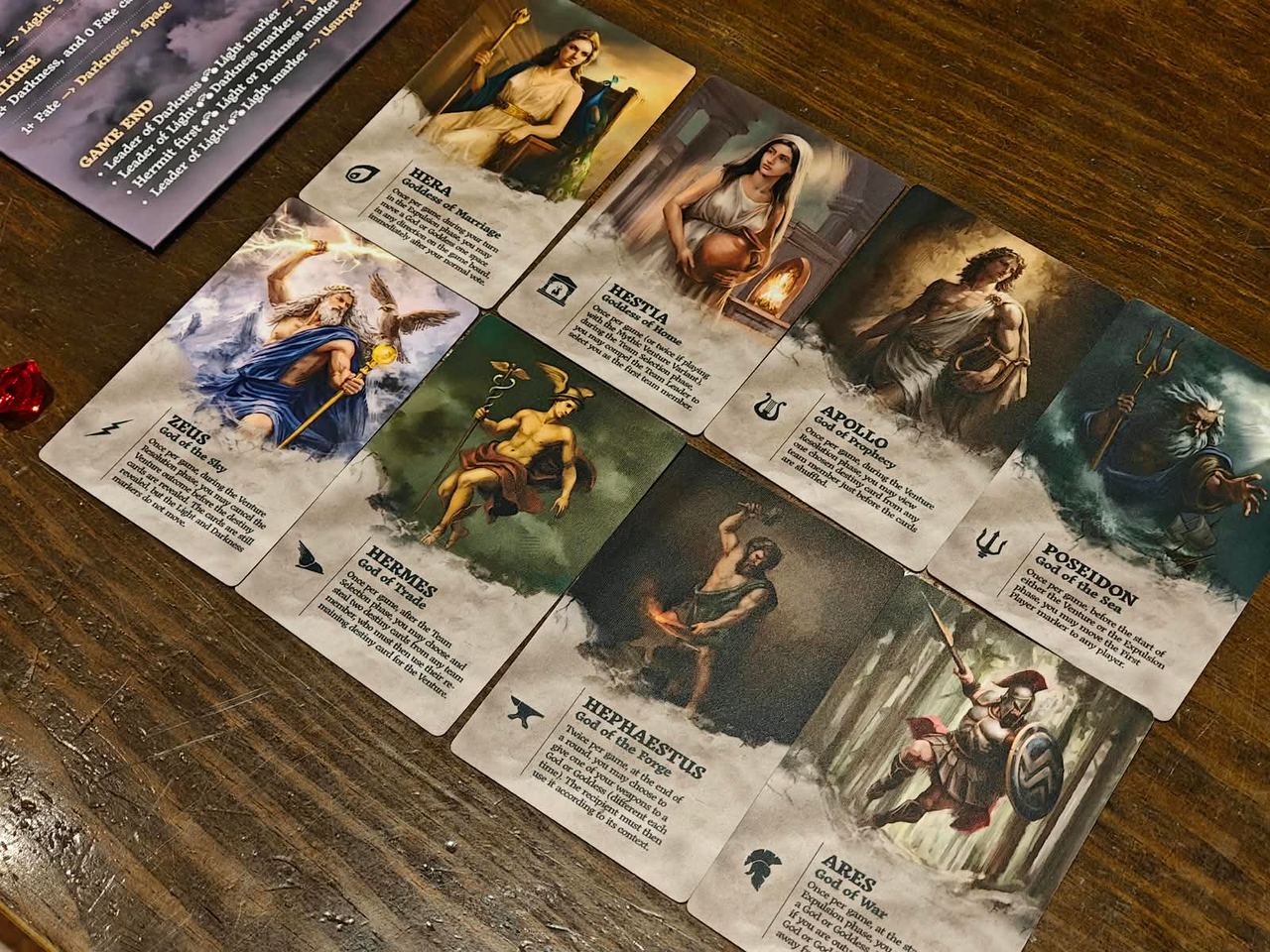
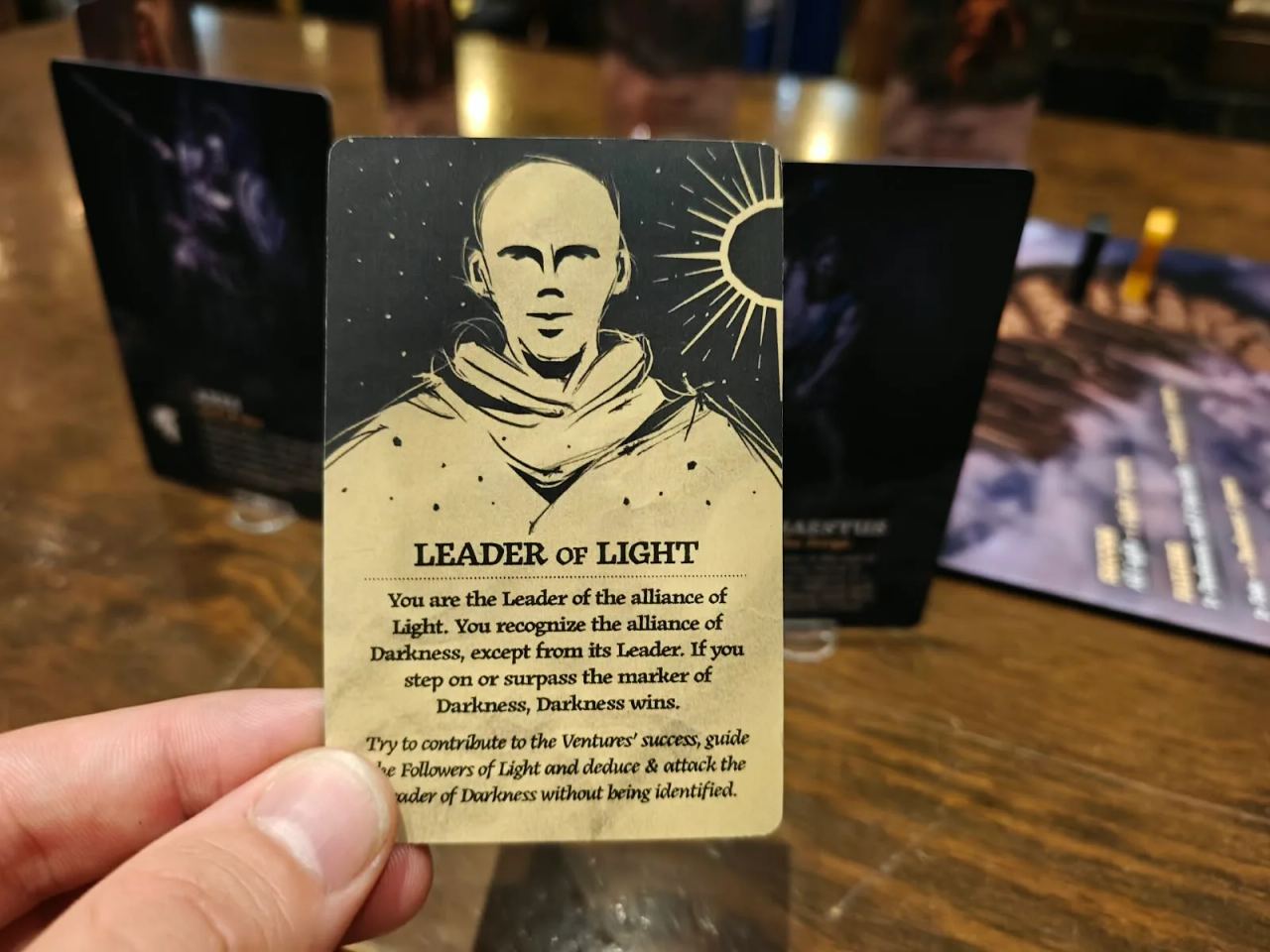
Each player receives two identities at once. On one hand, a public god card (Zeus, Hera, Athena, Poseidon, Apollo, Aphrodite, Hades, Ares, Artemis, Hermes, Hephaestus, Demeter, Hestia, or Dionysus, depending on the player count), with a unique divine ability that everyone knows from the beginning since they are public. On the other hand, secretly, a role card that establishes their actual alignment: Light, Darkness, or Solitary (a group of independent roles with their own victory conditions, such as the Hermit, the Usurper, the Scavenger, or the Arbiter).
Before the first round, there is a phase called "Night on Olympus" which is very common in secret identity or hidden role games: with eyes closed, the Darkness members acknowledge each other, and the Lord of Light observes who the members of Darkness are, along with a Light player disguised as Darkness, creating a false clue to sow doubt from the very first minute. If the Usurper or the Guardian of Light are in play, extra steps are added so they can spy on the Lord of Darkness or the Lord of Light, respectively.
From there, the game proceeds in rounds split into two phases:
Venture Phase: a Mythic Venture card is revealed, which determines which gods are eligible to be the leader (for example, "Zeus + 2" means Zeus leads and chooses two more team members). Players vote out loud in turn for the leader, and whoever wins the vote forms their team with complete freedom, without endless rounds of failed proposals that repeat to boredom as in other games of the genre. Each team member then receives three fate cards (Light, Darkness, and Doom) and secretly plays one. If all revealed cards are Light, the mission succeeds and the Light marker advances 3 steps; if any Darkness card appears (and no Doom), the mission fails and Darkness advances 3 steps; and if a Doom card appears, it overrides the result and advances Darkness by only 1 step. Afterward, each player can declare, truthfully or lying, which card they played.
Expulsion Phase: taking turns, each player points at a god other than themselves and moves them one step further down from Olympus. If a god reaches or passes the Light or Darkness marker, they become "expelled": they can still vote, lead or join teams, and even win the game, but from that point on they must play their fate cards face up, revealing much more information to the rest of the table.
The game ends the moment the Lord of Darkness is caught by the Light marker (the Light Alignment wins), the Lord of Light is caught by the Darkness marker (the Darkness Alignment wins), the Hermit is the first player expelled (wins solo), or the Usurper is in play and the Lord of Light reaches their own marker (the Usurper wins). In addition, Solitary roles can win alongside any alignment depending on their own victory condition.
The most fun part is that these god abilities aren't just cosmetic: they are designed to directly impact voting, fate cards, expulsion, or team composition. To give a couple of illustrative examples: if Hades is expelled, he immediately drags another god one step down with him; Aphrodite can sneak into a Venture by replacing a (male) god already chosen for the team, and Demeter can use her expulsion turn to move someone closer to Olympus instead of pushing them away. Every power affects an actual game system; it's not just fluff.
For those who want to take things a step further, the rulebook includes the Pantheon variant, which replaces Mythic Venture cards with Cosmic Venture cards and allows playing with any combination of gods regardless of the exact player count at the table.
Our thoughts
We should make an important clarification: we played a prototype version of Gods' Will, so some of these impressions—especially those regarding components, finish, or layout—might not match the final version that Kickstarter backers receive.
That said: Gods' Will openly presents itself as an heir to The Resistance: Avalon, along the same lines as The Resistance or Secret Hitler: two opposing teams competing to advance their side through successive votes. Drawing comparisons to popular titles is a common marketing tool to help potential players orient themselves and spark interest in acquiring the game.
While comparisons can sometimes be odious, in the case of Gods' Will we can conclude that it is quite similar to the mentioned titles (and to Werewolf, which is explicitly cited in the Kickstarter campaign), but it feels distinct enough from them by adding a few new mechanics that bring a breath of fresh air.
From our point of view, titles like The Resistance: Avalon or Werewolf have a few drawbacks that games like Blood on the Clocktower have largely addressed, and which Gods' Will also strives to overcome. We could say that the hidden roles genre generally suffers from three flaws, and Gods' Will addresses them as follows:
Player elimination or irrelevance after being revealed: in many hidden role games, having your role or secret identity revealed leaves you out of the game automatically. Not here: an expelled god keeps voting, can still lead ventures, and can still win. The only penalty is that from then on, they must play their fate cards face up.
Unequal spotlight among players: the variable abilities of each god ensure that everyone has a role with real weight in the game's outcome, rather than reserving interesting decisions for a lucky few roles.
Lack of replayability: the variety of gods with unique powers combined with the introduction of Solitary roles—independent roles with their own goals and playstyle—makes every game unique, offering virtually unlimited replay value.
One of the most noteworthy aspects (and one that adds great value to Gods' Will) is the seamless blend between mechanics and theme: the gods start at the top of Mount Olympus, and the votes in the Expulsion Phase push them downward, while successful or failed ventures push the Light and Darkness markers up from the base of the board until one of them "catches" the opposing leader. The theme plays a key role during gameplay and is brilliantly integrated into the design: it is elegant, visually attractive, and original.
Gods' Will introduces an additional element that is quite original: the Doom card. This card can be played by any player and serves not only to halt a venture suspected of being rigged by Darkness, but also allows Darkness itself (or Solitary players) to use it to muddy the waters and complicate deduction for everyone else. In some games like The Resistance, after just a couple of votes, it's already obvious who belongs to which faction or team.
The Expulsion Phase is one of the game's crucial elements and what sets it apart from other titles in the genre. It's the moment when the game stops being purely about deduction and turns into settling scores, forging alliances, and making personal choices about whom to push off Olympus that night, significantly heightening active, deliberate player interaction.
Leader selection via Venture cards avoids the classic deadlock in The Resistance: Avalon (and similar games) where failed votes repeat over and over: here, the card itself limits which players can lead each round, distributing the spotlight better and keeping the game moving forward.
On the artwork side, Michael Tsinoglou's work on the god cards is spectacular, and the overall setting of Olympus—with Mythic Venture cards pulling from a generous handful of ancient tales, including a reference to Ancient Egypt—will delight any fan of ancient mythology and history.
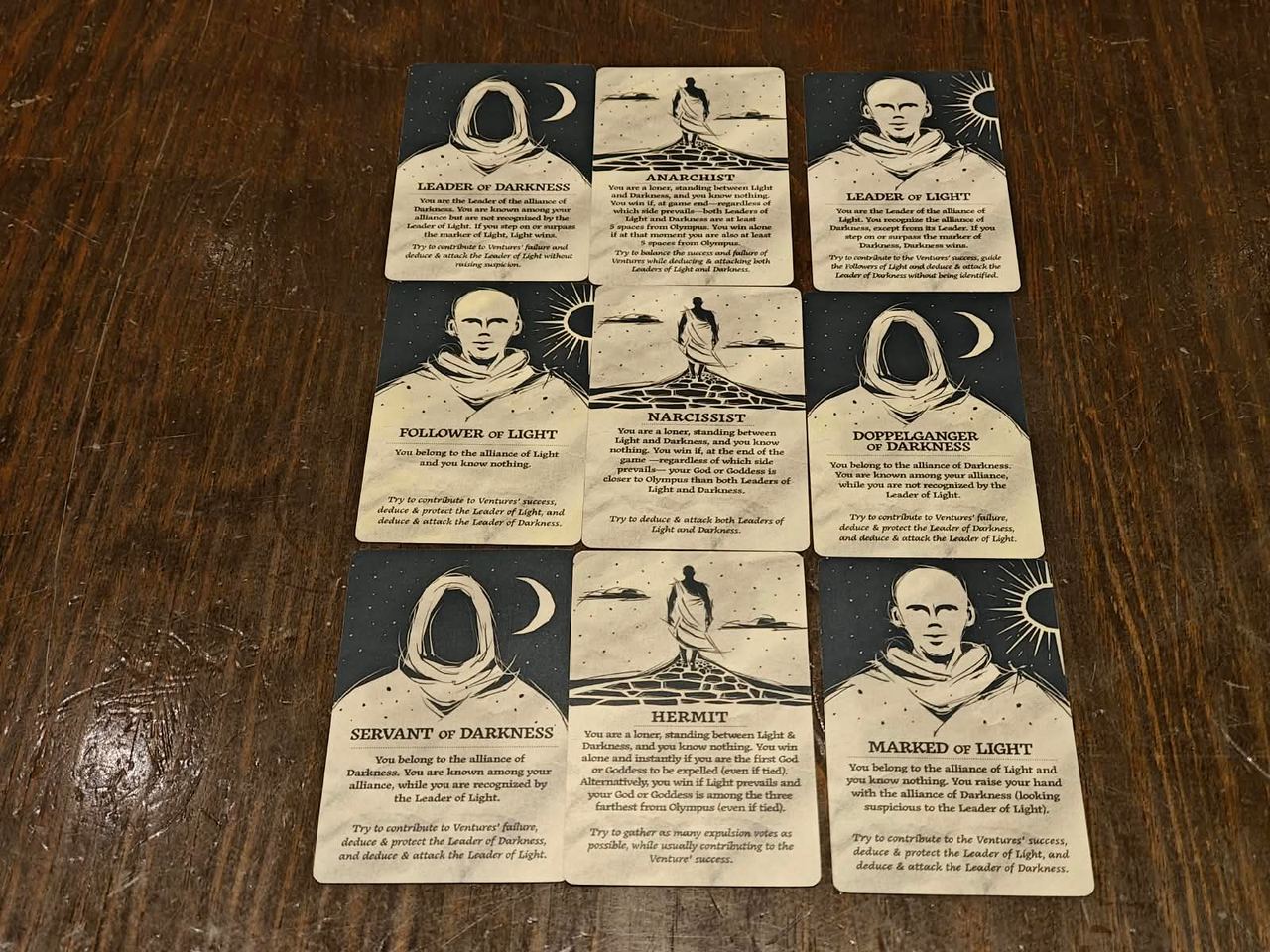
However, there is one genuine area for improvement: the role cards barely use iconography and rely on quite a bit of text to explain concepts that could be understood at a glance with two or three symbols; furthermore, all role cards of the same alignment share the same illustration, creating a noticeable contrast with the detailed god cards—something that could hopefully be improved for the final version.
Gods' Will doesn't reinvent the social deduction genre, but it is one of those rare designs that truly earns its comparison to established hidden role classics rather than merely riding their coattails.
If you enjoy games of accusations, lies, and high-pressure voting, Gods' Will is well worth checking out. You can find more details on its BoardGameGeek page, and if you'd like to back it, the campaign is still active on Kickstarter. And if you'd rather try it before deciding, you know where to find us: at our next game night.