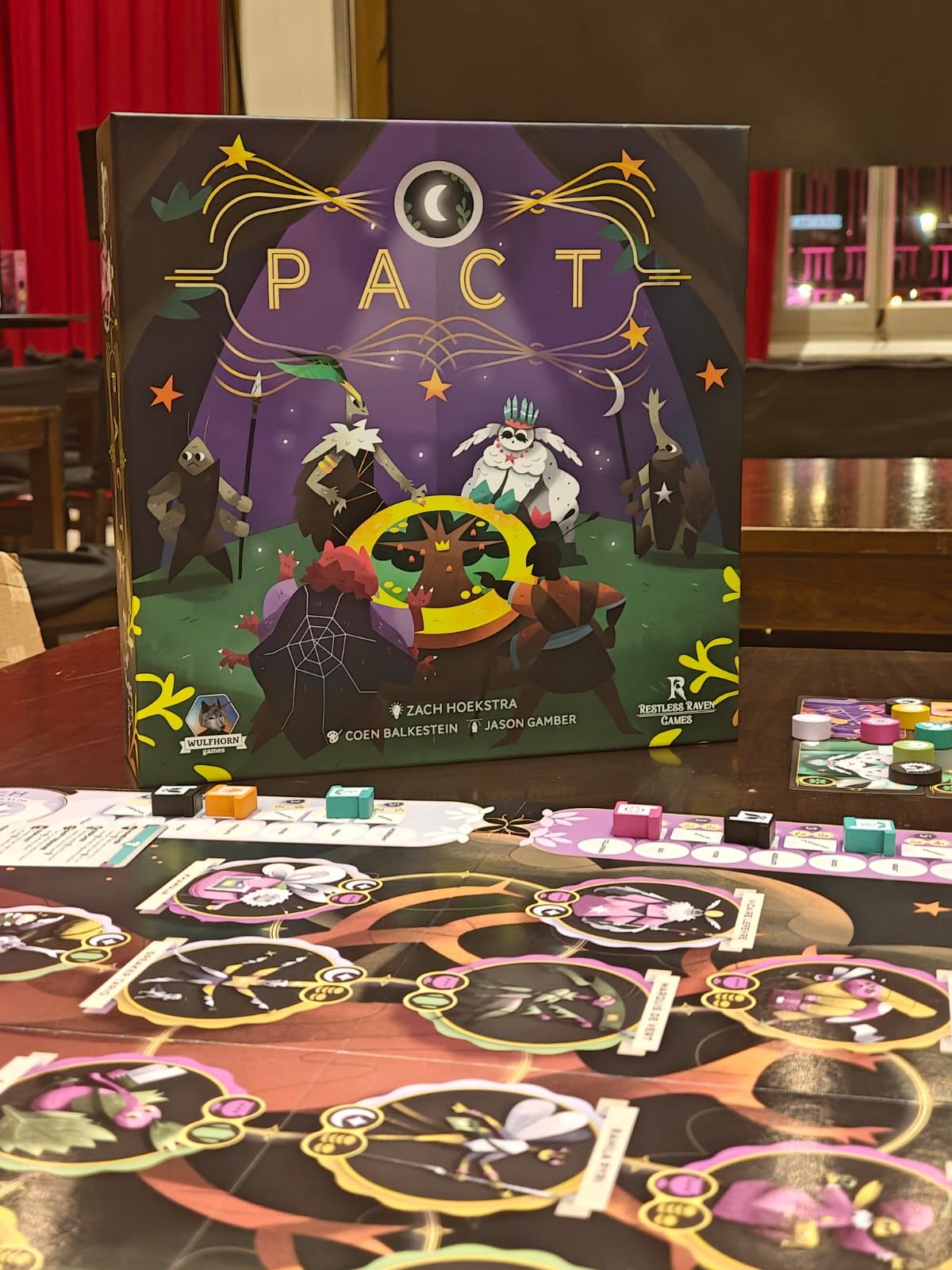
Pact, new game on Gamefound
If you like games where every decision comes with a price and helping your rivals is sometimes inevitable, PACT is going to interest you. It's the new board game from Wulfhorn Games, which is currently running its crowdfunding campaign on Gamefound. We've played it several times during our game nights with a prototype copy, and in this review we'll tell you how it works and what we thought of it.
Wulfhorn Games: the publisher behind PACT
Wulfhorn Games is a small publisher from the Netherlands, founded by Ruud Nederpelt and based in Diemen. On their website, they define themselves as a studio that offers "the complete package" of creativity: game design, graphic design, and illustration. Their catalog includes titles such as Stellar Expedition, Time Zoo, the cooperative game Bable, or Canal Houses, which recently arrived in Spain courtesy of Devir.
We were already familiar with their work from Council of Serpents, their previous game, also crowdfunded, which we reviewed on our website. There we already highlighted their polished visual design, and PACT keeps the bar high (we'll tell you why below).
What is PACT about?
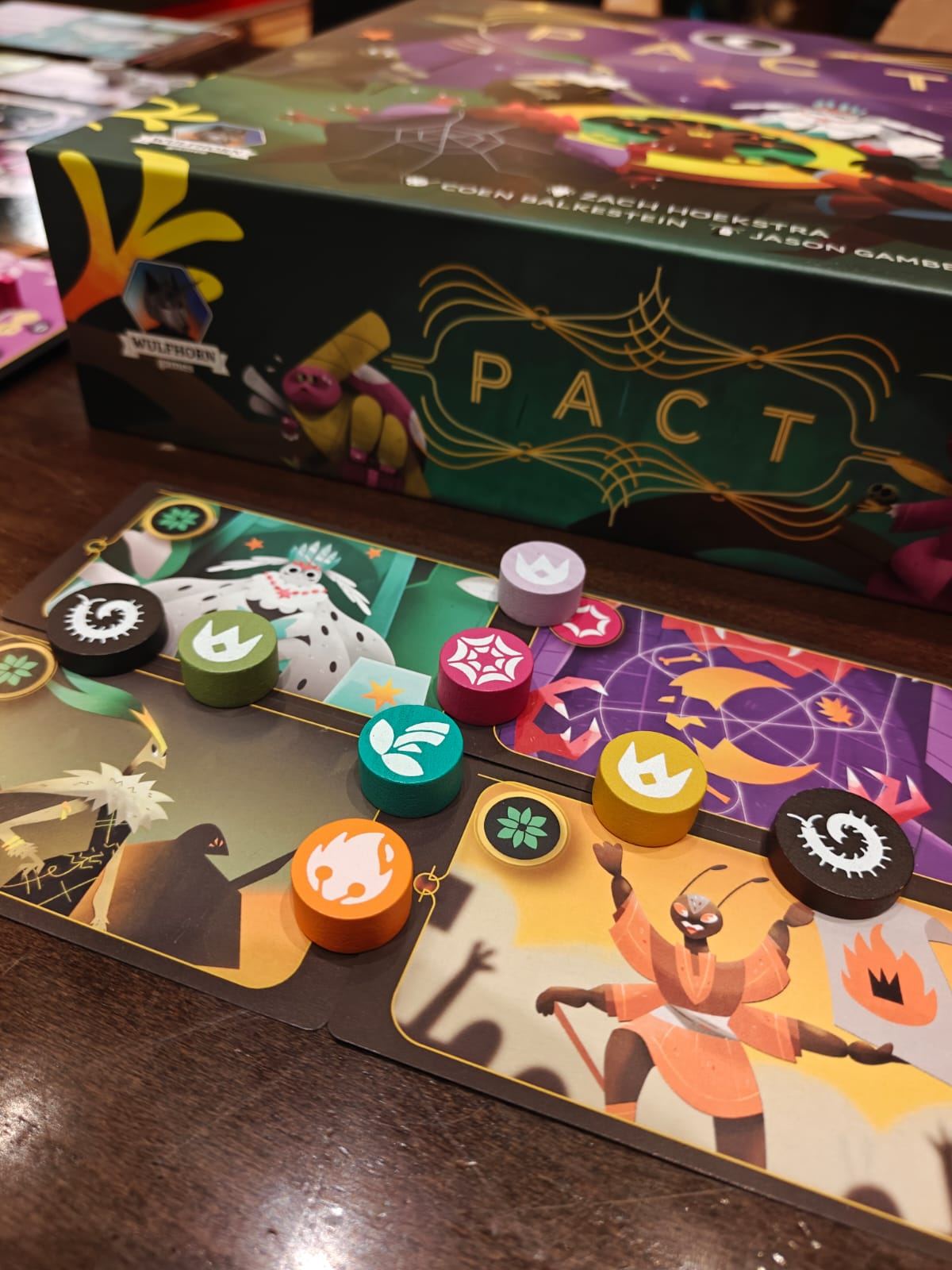
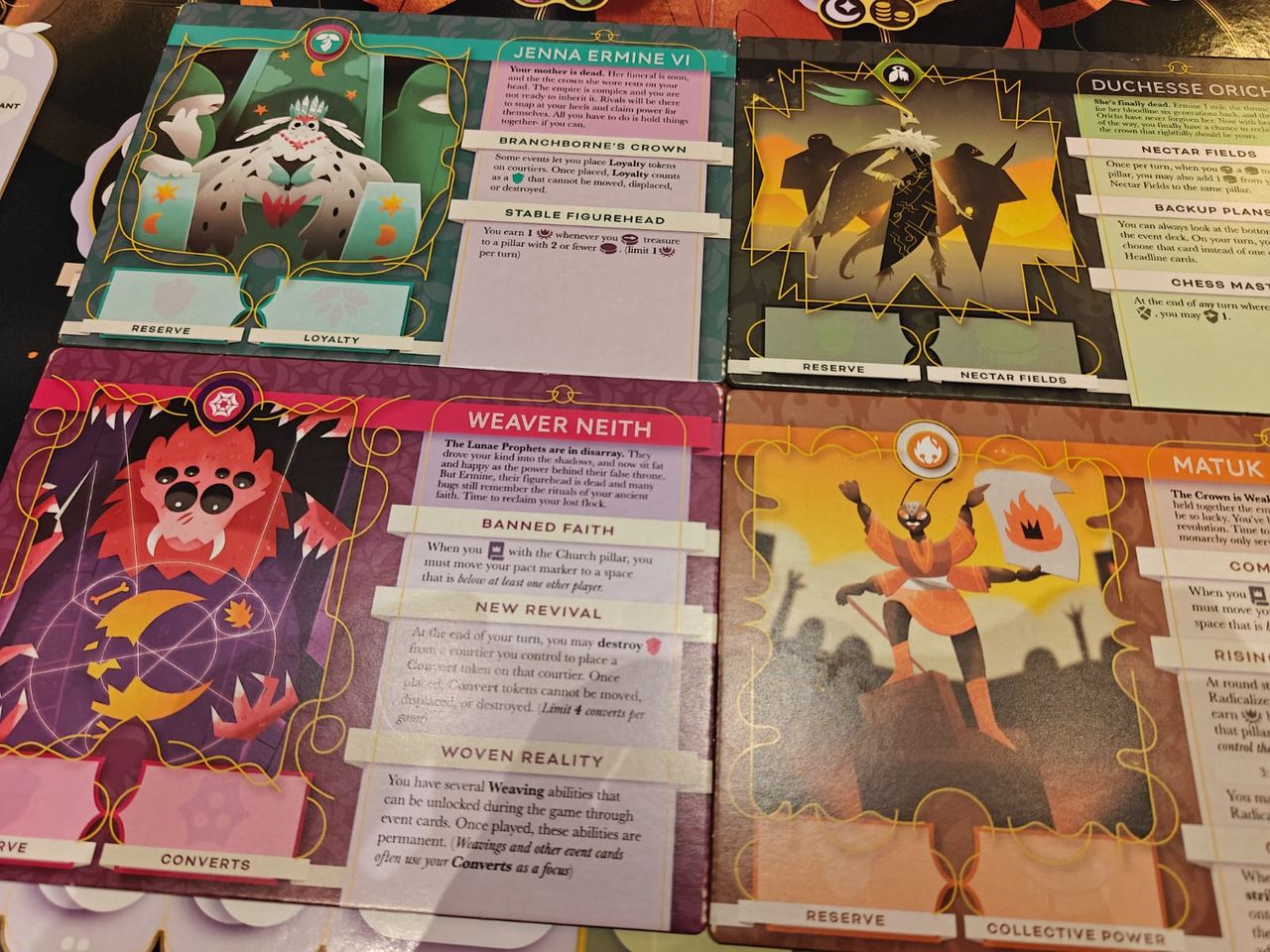
PACT is set in Branchbourne, a realm of tiny insects where a grand political game is played out in a miniature world. Young Jenna Ermine VI has just inherited the crown from her mother without allies and with threats on all sides. Duchess Orich, a forgotten rival to the throne, is laying claim to her right. Joining them are Matuk Inkclaw, the people's revolutionary, and Weaver Neith, the heretic, each with their own vision for the realm.
It's played by 3 to 4 players, with each person embodying one of these asymmetrical characters. The goal is to forge pacts with the four pillars of society (the Nobility, the Merchants, the Army, and the Church). These pacts give you influence, but they force you to keep your rich and powerful allies satisfied. Whoever manages to make their allies the happiest wins.
Components
The prototype edition includes:
A main board and a side board.
4 player boards, one per character.
36 character-specific event cards (3 autumn, 3 winter, and 3 spring per player) and 11 neutral event cards.
29 agenda cards (8 for Jenna, 7 for Orich, 7 for Matuk, and 7 for Neith).
64 influence tokens, 16 pact tokens, and 25 treasure tokens.
8 centipede tiles, pillar position tokens, legitimacy and turn order markers, and special tokens for each character.
How to play PACT
The board: pillars and courtiers
In the center of the board are 12 courtiers, the most influential figures in the realm. Each courtier belongs to two pillars and can manipulate the treasure of both. You control a courtier if you have more influence on them than any other player; in case of a tie, no one controls them.
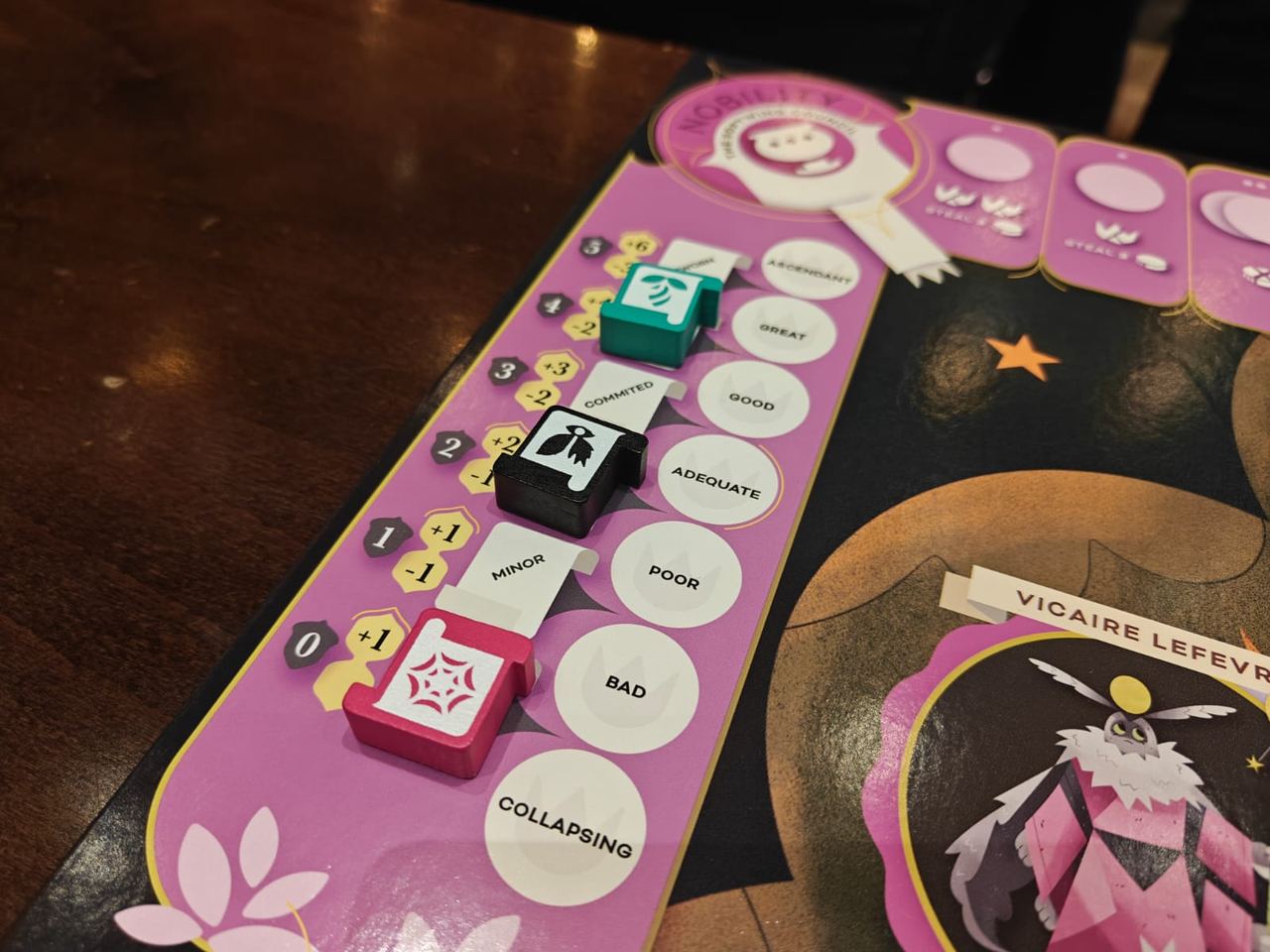
Each pillar has a treasure (the more money, the better it's doing) and a position on its status track.
The pacts
Every pact you sign with a pillar defines three things:
How much influence it grants you to use on the board.
How much legitimacy you gain each season if the pillar is doing better than you promised.
How much legitimacy you lose if the pillar is doing worse than promised.
In other words: an ambitious pact gives you more muscle on the board, but it also exposes you more.
Game structure: three seasons
The game lasts three seasons: autumn, winter, and spring. Each follows the same structure:
1. Start of the season. The event deck is formed using the 3 neutral cards for the season and each player's 3 personal cards (12 cards with 3 players, 15 with 4). They are shuffled and 4 cards are revealed: the "headline row". Then the turn order is set (whoever has the most legitimacy goes first) and each player secretly and simultaneously chooses an agenda card, a sort of mini-mission that rewards them for completing a specific objective.
2. Player turns. This is the heart of the game. On your turn, you choose one of the 4 cards from the headline row. Each card has actions on the left and an event on the right, along with a character emblem:
If it belongs to another player (or is neutral): you perform all the actions on the left, from top to bottom, and then hand the card to that player, who can apply the event on the right. If the card is neutral, the event usually affects everyone or the active player.
If it bears your emblem: you choose between the actions or the event, but not both.
After each turn, the row is refilled back to 4 cards. Each player plays 3 cards per season, leaving 3 unused.
3. The four actions.
Move influence: each movement point allows you to move an influence token to an adjacent courtier (connected by a golden line) or place one from your reserve onto a courtier where you already have influence.
Displace influence: you send rival tokens to the "displaced" zone until the next season. You can only do this in courtiers where you have your own influence.
Move treasure: with each courtier you control, you shift a coin from one of its two pillars to the other. Each courtier can only move one coin per turn, so to move a lot of money you need to control several courtiers.
Sign pact: you move your pact token on a pillar to any free slot, or add/remove it. If you go up, you gain influence; if you go down, you lose it. Matuk and Neith are frowned upon by specific pillars, so they can never hold the highest pact of the game with them.
4. Pillar turns. When the cards run out, the pillars take action in order, starting with the Merchants and following counter-clockwise. Each one looks at how much treasure it has and applies the effect of its tier:
Merchants: with little money they enter a recession, with a medium level they prosper, and if they exceed 8 coins they suffer an economic bubble.
Nobility: with little treasure they steal from other pillars; with a lot they become opulent.
Church: if it's doing poorly, it curses other pillars; if it's doing well, it blesses and raises the status of others.
Army: depends on having enough funds to hold back the centipedes.
This means you don't want a pillar to have the maximum possible money, but rather to be in the right tier. And since each player wants the pillar in a different spot, the treasure becomes a constant tug-of-war.
5. The centipede threat. Each season, the centipedes hidden in the roots are revealed and their strength is compared to the Army's defense. If the Army fails twice, the centipedes devour the realm and all players lose (catastrophic defeat). It's a shared threat within a highly competitive game, and it forces you to think about the big picture.
6. The realm deliberates. Each player reviews their pacts:
If the pillar's status is above your pact token, you gain the legitimacy indicated by that pact.
If it's below, you lose legitimacy.
Then, the player with the least legitimacy goes back to 0 and everyone else drops the exact same number of spaces, meaning only the distance to last place matters.
7. End of season. The season marker is advanced and the displaced influence returns to the reserves.
How to win
There are two ways to win:
Domination victory: if at the end of any season a player has 13 or more legitimacy points than the last-place player, they win immediately.
Standard victory: if no one achieves this, whoever has the most legitimacy at the end of spring wins. Ties are broken by turn order.
Asymmetrical characters
Each character has their own rules and player board:
Jenna Ermine VI can place loyalty tokens on courtiers that cannot be moved, displaced, or destroyed, and gains extra legitimacy when moving treasure towards pillars with little money.
Orich, Matuk, and Neith have their own abilities and tokens (Neith's converts, Matuk's strike and radicalization tokens...), as well as distinct agenda decks.
Our opinion on PACT
A very interesting medium-weight game
It's no secret to tell you that our game nights usually feature light games or medium-weight games. PACT is a medium-weight game designed for players who have already tried slightly more demanding mechanics: area majorities, card drafting, pact management, and board control. Even so, we think it's a great game for anyone looking for a more complex "gamer's game" or "euro-plus" level experience. Its difficulty sits in a range similar to The Castles of Burgundy or Lost Ruins of Arnak, to name two very well-known titles.
An important point in its favor: the player aids and the cards themselves are very well explained. The summary card and the actions printed on the left of each event make it easy to follow the turn order and know what you can do at any moment, even in your first games. The rulebook also suggests choosing the agendas marked with a sprout icon for your first game, which helps you jump in without feeling overwhelmed.
Graphic design and production
Just like in Council of Serpents, the artistic department is outstanding. The characters have personality, the board features a huge tree full of courtiers, and the iconography is clear. And we say this having played with a prototype: we expect the final edition to match or exceed this level.
The political theme is baked into the mechanics
Many "political" games stop at the wrapping paper and completely forget about the mechanics and theme. In PACT, politics is the game system itself: you negotiate with your allies through pacts, keep them happy by moving money around in ways that sometimes harm other pillars, and every decision has consequences in the realm. Moving a single treasure token can feed one ally and leave another starved of resources. Furthermore, the theme—while seeing insect kingdoms isn't very common—is very well integrated into the game.
Other strengths we found
The constant dilemma of the card. Each card gives something to you and something to a rival, so choosing means deciding who you help. There is no "free" card, and that generates a tension that keeps everyone alert even when it's not their turn.
A tug-of-war with the treasure. Each pillar has a "sweet spot" and players want different things. That's why the same pillar can be a target for some and a victim for others.
Real asymmetry. The four characters feel distinct, and Matuk and Neith's "frowned upon" rules add a very interesting balance to the pacts.
A legitimacy system that keeps the tension high. Since the last-place player always resets to 0, the games stay tight and no one gets left too far behind. At the same time, the domination victory rewards whoever plays with determination.
A common threat that forces you to look at the entire board. The centipedes add a nearly cooperative element that prevents the game from turning into a purely closed duel.
Contingent duration and low downtime. With only 3 cards per player in each of the 3 seasons, and with cards that make you participate in other players' turns, the game moves at a brisk pace.
Replayability. Different card decks per character, agendas that change each season, 5 neutral spring cards of which only 3 secretly enter play, and random centipedes ensure every game is different.
The art speaks for itself. A large portion of Wulfhorn Games' titles have a very distinctive visual style, making them easily recognizable.
Things to keep in mind
We played with the prototype rules (version 0.1), so some details may change in the final edition. Also, player interaction is high: if you don't like having your influence displaced or having the pillar you were taking care of "stolen" from you, you might find it tougher at first. For anyone who enjoys thoughtful conflict, that's part of the fun.
Is it worth backing PACT on Gamefound?
If you are drawn to area majority games with high interaction, polished production, and a design that integrates theme and mechanics, PACT is a highly recommended bet. Our experience with Council of Serpents and the games we've played of PACT over the last few weeks give us confidence in Wulfhorn Games' work.
You can check out all the campaign details, pledges, and stretch goals here:
And if you want to know more about the publisher, visit the Wulfhorn Games website.